Selected work — case study
Alutal FPSO: an interactive 3D app for Rio Oil & Gas
A cross-platform app that turned a printed brochure into an explorable 3D FPSO, used as a tablet kiosk at Alutal's Rio Oil & Gas booth.
- Role
- Mobile developer
- Timeline
- 14 days
- Stack
- React Native · Expo · TypeScript
A cross-platform app with a 3D FPSO vessel, built for Alutal's booth at Rio Oil & Gas, the largest oil and gas trade show in Latin America, which drew about 83,000 people. Visitors explore the vessel by touch and find, in each area, Alutal's solutions to the challenges at that point. At the show, the app ran on a tablet set up as a kiosk.
- days of development
- 14
- layers per point of interest: process, challenge and solution
- 3
- platforms: Android and iOS
- 2
Context
Alutal took part in Rio Oil & Gas as an exhibitor, with a booth built for the show. Their presentation material already existed as a printed brochure, with the content they wanted to get across to visitors.
Problem
The brochure already did its job as printed material, but Alutal wanted to bring something different to the booth: an interactive experience that could work as a kiosk and draw in the visitors walking the floor. The challenge was turning the brochure's content into an interactive mobile app, and deciding what shape that interactivity would take.
Approach
- 01
- From brochure content to a 3D FPSO
The starting point was the content Alutal already had in the brochure, and the first app idea was simpler. Talking through what they wanted visitors to understand, we landed on a more ambitious proposal: a 3D model of an FPSO that visitors could explore directly, with the content spread across the vessel's own structure.
- 02
- Points of interest tied to Alutal's solutions
The vessel has predefined points of interest spread across its structure. Each one opens the same three layers: the process that happens in that area, the challenge involved, and which Alutal solutions address it. Keeping this structure fixed means every point reads the same way, and the product always comes last.
- 03
- React Native, Expo and TypeScript
I suggested this stack because my background is React, and most of it carries over: components, state, hooks, how a screen is structured. Some things behave differently from React on the web and need attention, but the learning curve was much shorter than moving to a different mobile stack.
- 04
- Cross-platform, deployed as a tablet kiosk
The app was built for mobile and, at the show, ran on a tablet working as a kiosk at the booth, used directly by visitors.
What a visitor does at the kiosk:
Explores the 3D FPSO on the tablet.
Taps one of the points of interest on the vessel.
Reads the process in that area and the challenge involved.
Sees which Alutal solutions address that challenge.
Launch video
A motion design piece I made to present the app, originally published on my LinkedIn.
At the booth
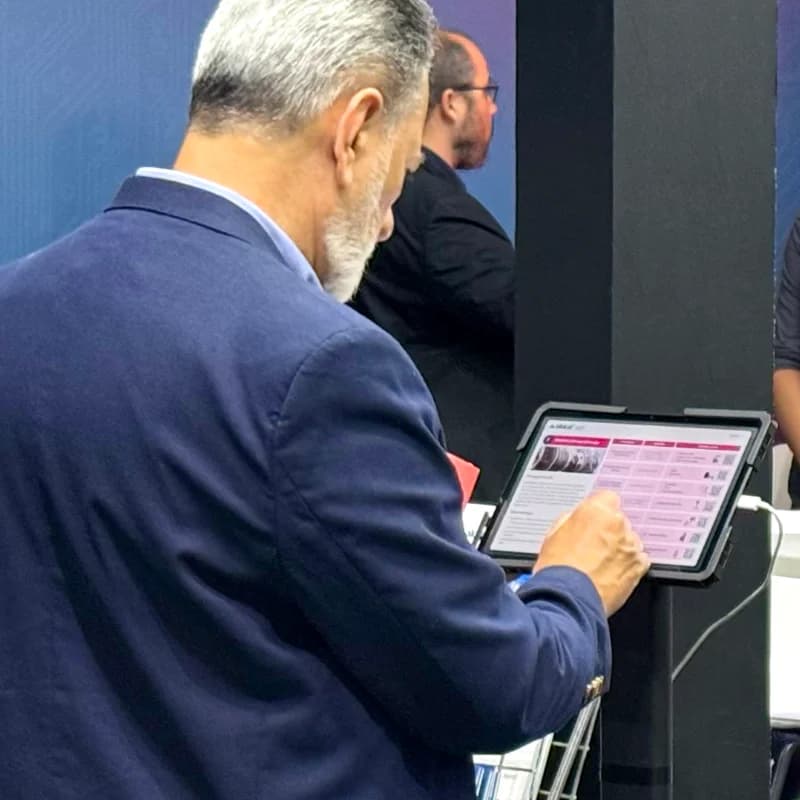
Alutal shared its own recap of the show, including a photo of visitors using the app at the kiosk.
Outcome
The app went to Rio Oil & Gas as the interactive centerpiece of Alutal's booth, running on the kiosk throughout the show. On my side, it was the project that consolidated React Native and Expo for me: I came out much more comfortable with mobile than I went in.